
Tile roof homeowner guide
Tile roof repair in San Diego
The problems we fix most on clay and concrete tile roofs around the county, what each repair costs in 2026, and how to tell if your roof needs a patch, a lift and relay, or a whole new roof before the rain starts.
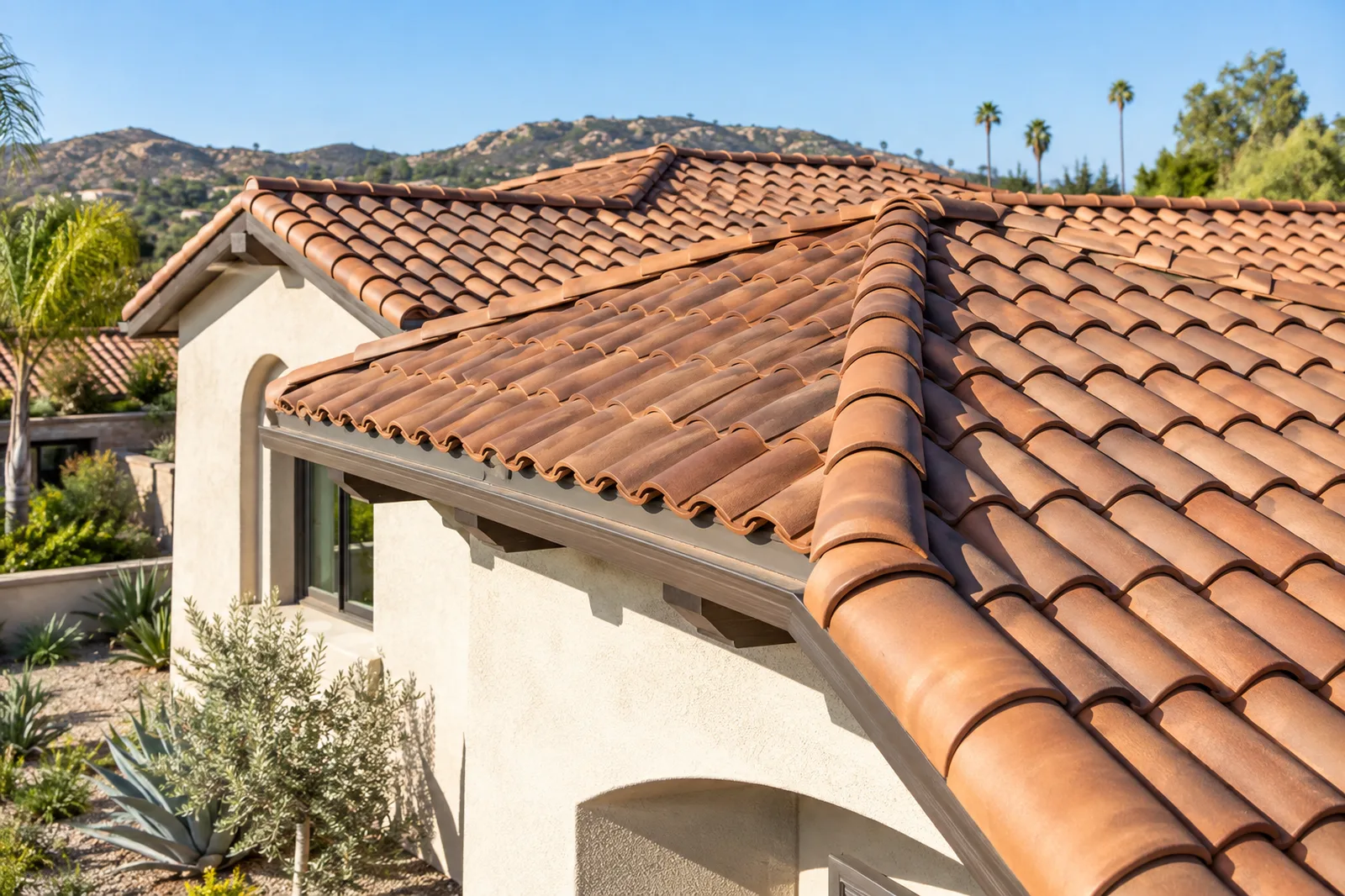
Tile is everywhere in San Diego County. Spanish style homes in Kensington, tract homes in Rancho Bernardo and Mira Mesa, the big hillside houses in Escondido and San Marcos. Most of them have concrete or clay tile, and most of those roofs went on 20 to 40 years ago.
Tile is tough stuff. A good tile can outlast the house. But a tile roof still leaks, and when it does, people are often surprised. “I thought tile roofs last forever.” The tiles might. What’s under them doesn’t.
We repair tile roofs all over the county every week. This guide covers what we actually find up there, what the fixes cost right now, and how to know when patching stops making sense. October is a great time to read it, because once the first real storm hits, every roofer in town gets booked up fast.
Quick answer
The short answer
Most tile roof problems can be repaired. Cracked tiles, slipped tiles, crumbling ridge mortar, bad flashing and clogged valleys are all fixable without tearing off the roof. Simple repairs usually run $250 to $1,800 in San Diego County. Flashing and valley work runs more.
The time repairs stop making sense is when the underlayment under the tile is worn out. That’s the black layer that does most of the waterproofing. Once it’s brittle and cracking across the whole roof, you’re chasing leaks. Then a lift and relay, where we take the tile off, put down new underlayment and put the same tile back, is usually the smarter money.
Know your roof
How a tile roof keeps water out
A tile roof works in two layers. The tile on top sheds most of the rain and blocks the sun. Under the tile is the underlayment, usually felt paper on older homes and synthetic or self-adhered membrane on newer ones. On a lot of roofs there are also wood battens, the strips the tile hangs on.
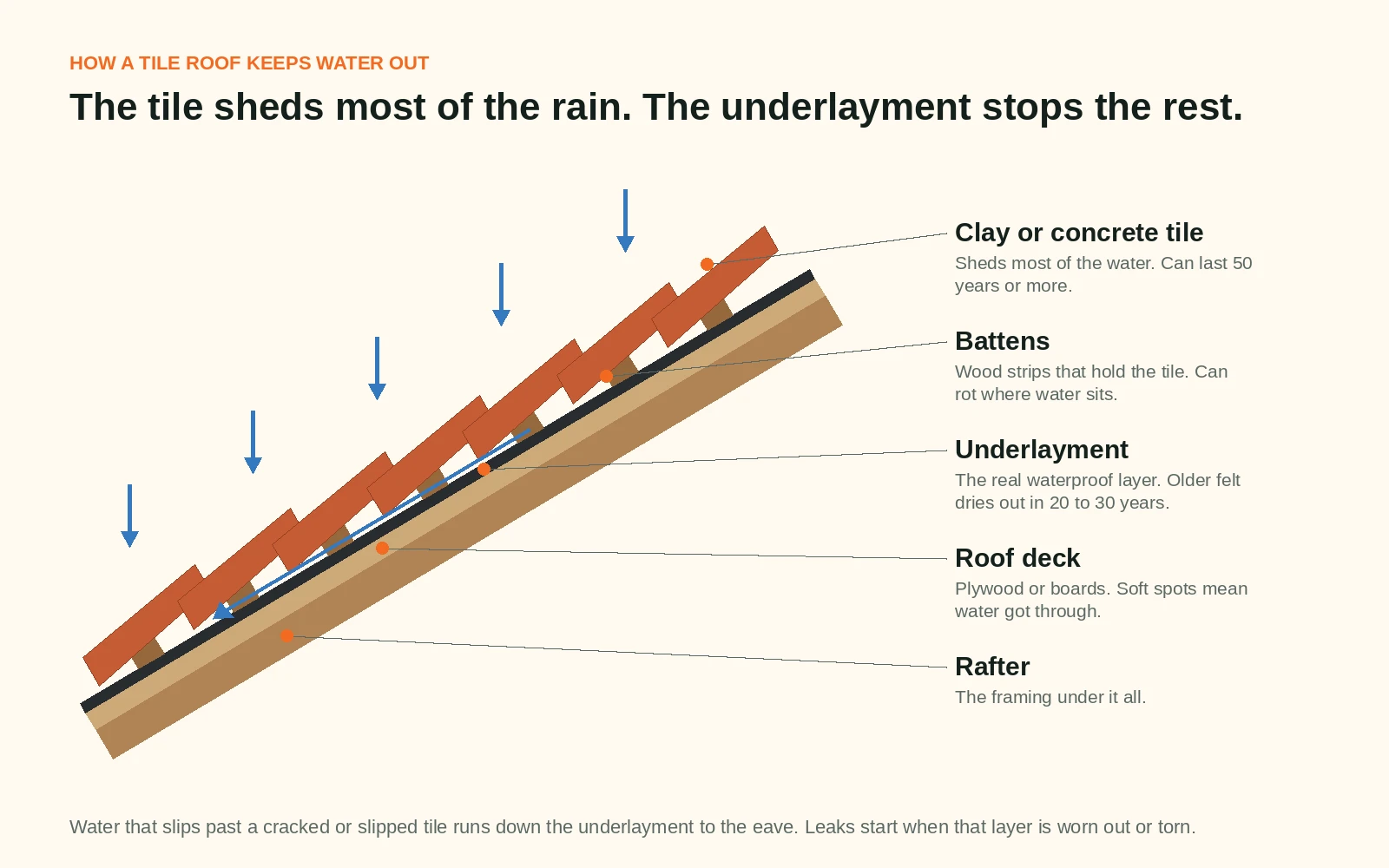
Tile isn’t sealed together. Some water always gets under it, especially in a windy storm. That’s normal and the roof is built for it. The water runs down the underlayment and out at the edge of the roof.
Problems start when that bottom layer can’t do its job anymore. San Diego sun and heat are hard on old felt. It dries out, gets brittle and cracks, especially at the eaves and in valleys where water sits longest. Inland roofs in El Cajon, Santee, Escondido and Poway tend to wear out faster than roofs near the coast, just because they bake more every summer.
So when we talk about tile roof repair, we’re really talking about two things. Fixing the tile and metal you can see. And figuring out if the layer you can’t see still has some life left.
What we find
8 common tile roof problems we fix in San Diego
These are the repairs we do the most, roughly in order of how often we see them.
- 01
Cracked and broken tiles
Usually from someone walking on the roof. Solar installers, cable guys, painters, holiday light hangers. Tile has to be stepped on in the right spot, low on the tile where it overlaps the one below. Step in the middle and it snaps. A few cracked tiles aren’t an emergency, but each one lets more water and sun reach the underlayment.
- 02
Slipped or missing tiles
Old nails rust out, clips let go, or a tile was never fastened well. Tiles slide down and leave a gap. Santa Ana winds in the fall can shift loose tiles too. Usually a quick fix if the tile isn’t broken.
- 03
Crumbling ridge and hip mortar
A lot of older San Diego roofs have mortar holding down the ridge and hip tiles. After 20 or 30 years it cracks and falls out in chunks. You’ll sometimes find pieces in the gutter or on the patio. We re-set loose caps and fill the gaps, or switch to a newer dry ridge system on bigger repairs.
- 04
Clogged or rusted valleys
Valleys carry more water than any other part of the roof. Leaves from pepper trees, eucalyptus and palms pile up in them and dam the water. Near the coast in Oceanside, Carlsbad and Point Loma, salt air rusts out old galvanized valley metal. A lot of the leaks we find start right here.
- 05
Wall, chimney and skylight flashing
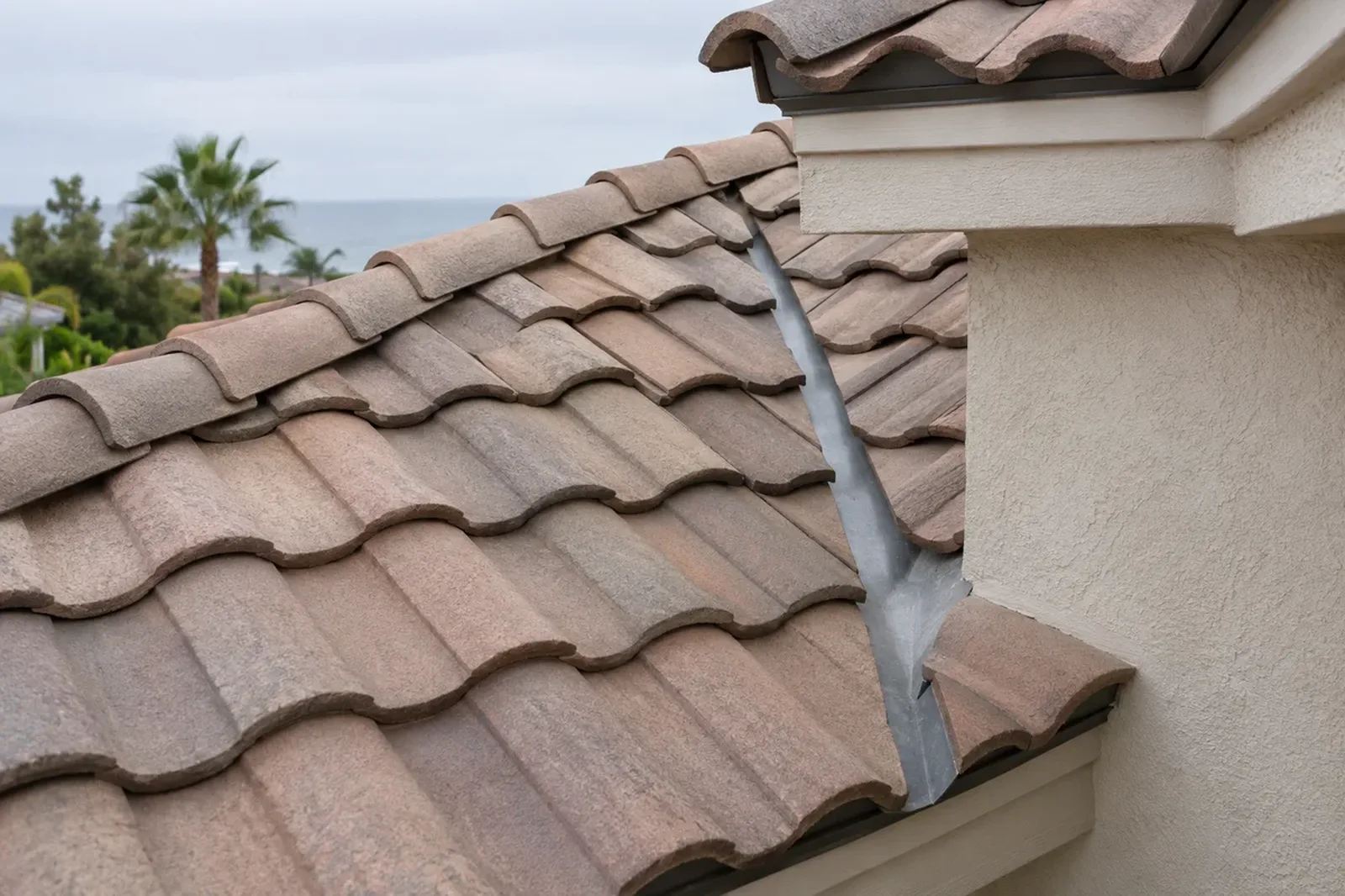
Anywhere the roof meets a wall or something that sticks up through it, there’s metal flashing. Stucco cracks, sealant dries out and old flashing rusts. Water gets behind it and shows up as a stain on the ceiling or a bubble in the stucco below.
- 06
Pipe and vent leaks
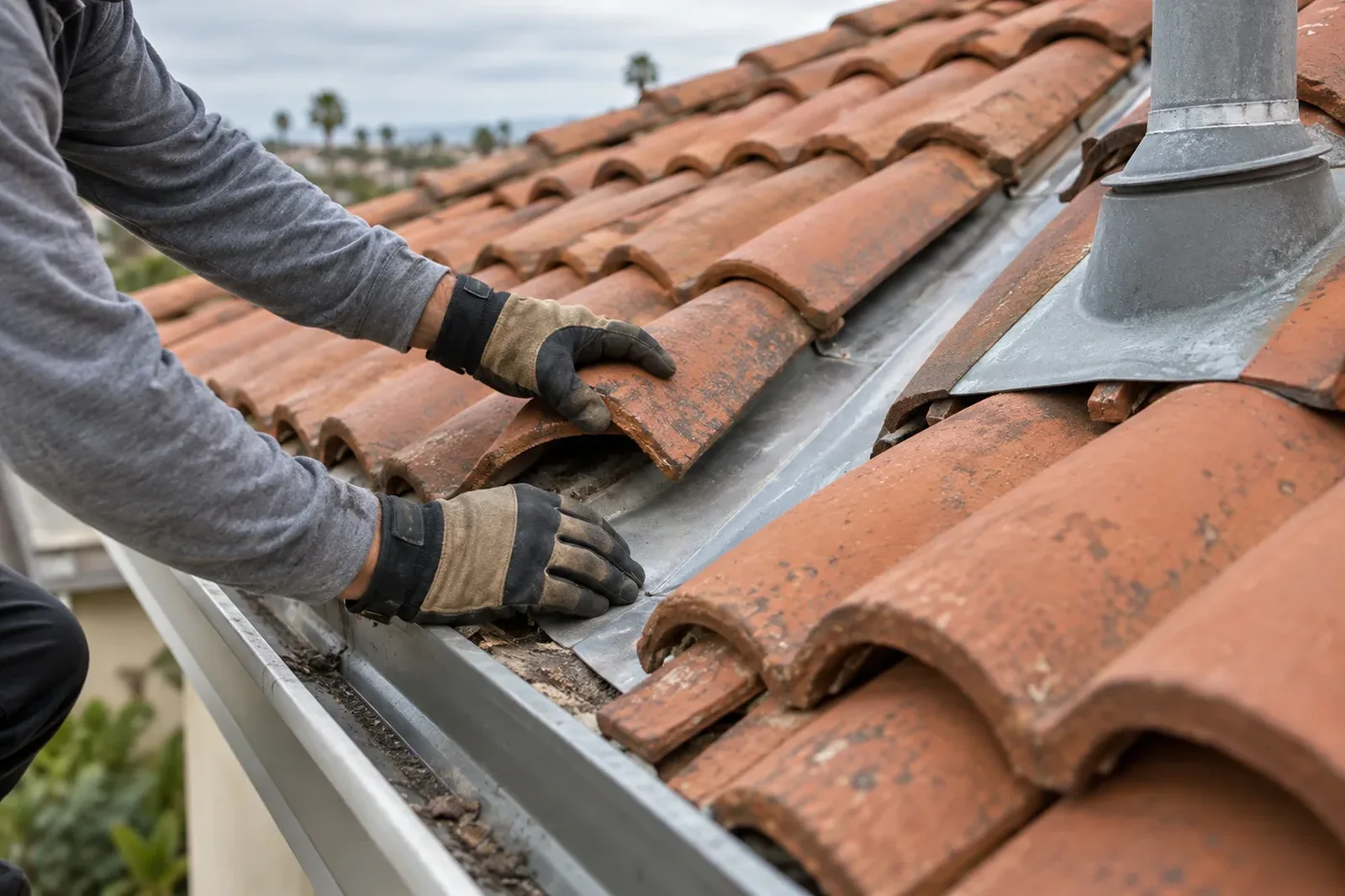
Plumbing vents and attic vents need lead or metal flashing that’s dressed down over the tile. Lead gets chewed by critters and old flashing cracks. These are usually cheap fixes if you catch them early.
- 07
Birds and rodents at the eaves
Pigeons and other birds love nesting in the open ends of curved tiles at the eave. Rats get in there too. Nests hold water and push up the tile, and the droppings make a mess. Bird stops, which are metal or foam closures at the first row, keep them out.
- 08
Worn out underlayment
The big one. If the felt is brittle and torn in a lot of places, no amount of tile swapping will stop the leaks for long. On repairs we lift a few tiles in different spots to look, and we’ll show you photos of what we found.
If your roof is on the older side, our tile roof underlayment replacement guide goes deeper on that last one.
Budget
What tile roof repair costs in San Diego
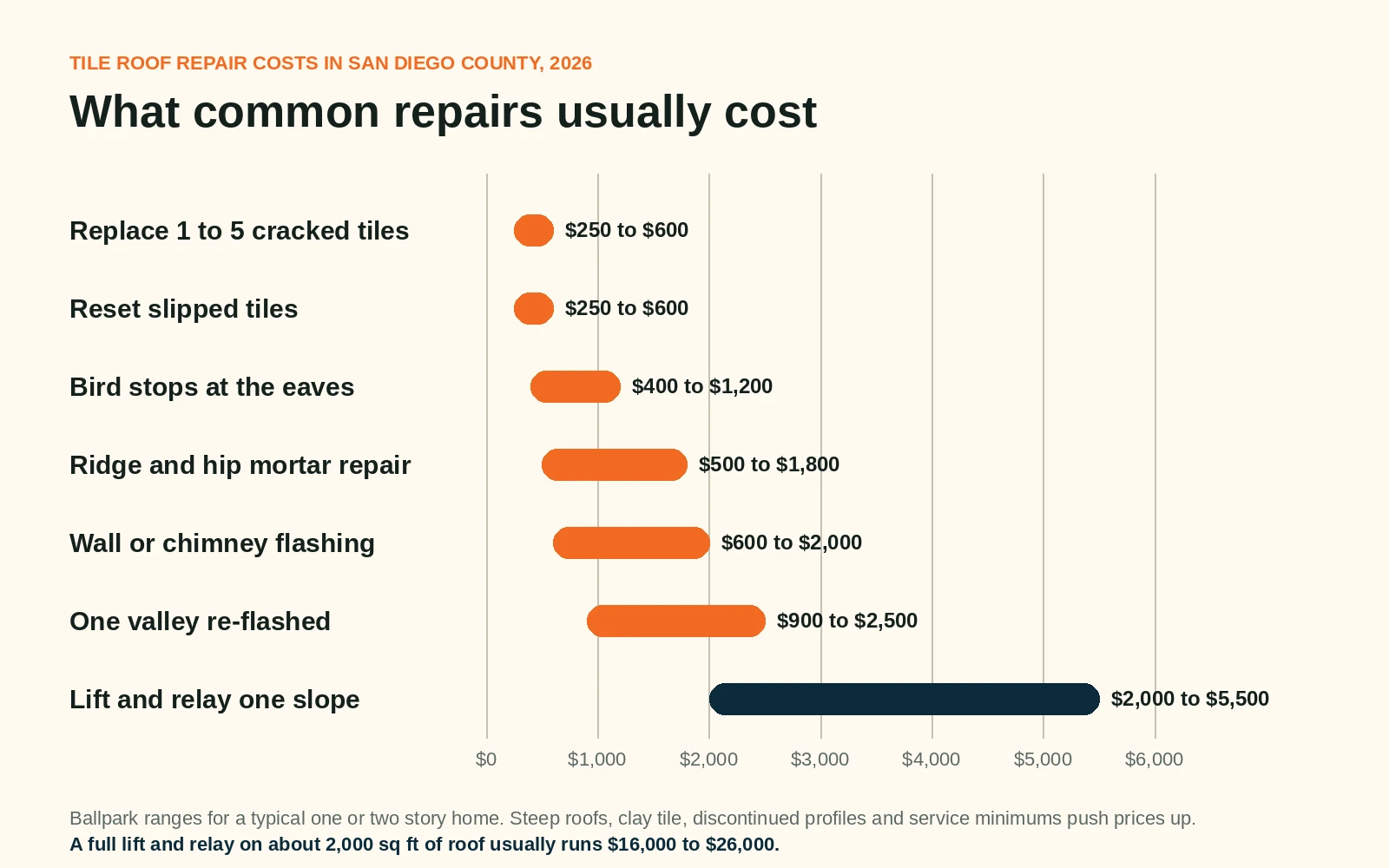
Prices depend a lot on how steep and tall the roof is, whether it’s clay or concrete, and how easy it is to find matching tile. These are the ranges we see around San Diego County in 2026 for a normal one or two story home.
What pushes the price up
- Clay tile. Clay is more brittle and costs more to replace than concrete. Some old clay profiles are hard to find.
- Steep or two story roofs. More safety gear, more time.
- Hidden damage. Rotted battens or soft plywood under a leak get found once the tile comes off. A good roofer will stop, show you, and price it before doing extra work.
- Service minimums. Most companies have a minimum charge to roll a truck and set up ladders, even for one tile.
- Emergency calls. Fixing something in the middle of a storm costs more than fixing it in October.
When a repair turns into a lift and relay
A full lift and relay on a typical 2,000 square foot roof usually runs about $16,000 to $26,000, or about $8 to $13 a square foot. That’s a lot less than brand new tile, because you keep the tile you have. Our roof replacement cost guide for San Diego lays out how that compares to new shingles, new tile and metal.
One more thing on cost. If someone quotes you $150 to “seal” your whole tile roof, be careful. Spraying coatings or caulking the joints between tiles doesn’t fix underlayment, and it can trap water. We see the aftermath of that a few times a year.
Your options
Repair, lift and relay, or replace
Here’s how we help people decide. It mostly comes down to the age of the underlayment and the shape of the tile.
Fix the problem area
Best when the roof is under about 20 years old, the leak is in one place, and the underlayment we see under lifted tiles is still flexible. Most cracked tile, flashing, vent and ridge jobs land here. You get more years out of the roof for a few hundred to a couple thousand dollars.
Roof maintenanceNew underlayment, same tile
Best when the tile is in good shape but the felt is shot. Common on roofs from the 1980s to early 2000s. We take the tile off and stack it, replace the underlayment, flashings and battens as needed, and relay the tile. You get the waterproofing of a new roof and keep the look of your home.
Tile roofingNew roof altogether
Best when the tile itself is failing. Some older lightweight concrete tile gets brittle or soft and breaks too easily to reuse. Sometimes a homeowner wants a lighter roof or a new look. Then new tile, stone coated metal or shingles may make more sense.
Shingle roofingSigns you’re past the repair stage
- Leaks in two or more different rooms over the last couple of winters.
- Felt that crumbles or tears when we lift a tile.
- Water stains along the eaves on the outside of the house or on the soffit boards.
- Soft spots in the roof deck that you can feel from the attic.
- A roof that’s 25 to 30 years old and has never had the underlayment replaced.
Roof age also matters for your homeowners policy. Some insurers here are asking for roof inspections or dropping older roofs. Our guide to roof age and home insurance in California explains what they look for.
Tile matching
Finding replacement tiles that match
This is the question we get on almost every tile repair. “Can you match it?” Usually, yes. Sometimes it takes some work.
Concrete tile in San Diego mostly comes in a few common shapes. Flat, low S and high S (the round “Spanish” look). Many of the colors from the 1980s and 1990s aren’t made anymore, and older tiles fade a lot in our sun. A brand new tile in the “same” color can look very different next to a 25 year old one.
Here’s how we handle it:
- Check your garage and side yard. A lot of builders left a stack of extra tile behind. Those are perfect because they’ve aged with the house, at least a little.
- Borrow from a hidden spot. We can pull tiles from a slope nobody sees, like the back of a garage roof, use them on the front, and put the closest new match in the hidden spot.
- Salvage tile. There are yards around Southern California that sell used tile. For discontinued profiles, that’s often the only way to get a real match.
- Clay tile. Clay keeps its color much better than concrete, so matching is often easier. It’s also more fragile, so we order a few extra.
If you’re in an HOA, check your rules before any tile goes back on. Many San Diego HOAs list approved tile colors and profiles, and some want to sign off before work starts.
Rainy season
What to do before the rain starts
San Diego doesn’t get a lot of rain. About 10 inches a year at the airport, and a good bit more in the inland valleys and foothills. But most of it shows up between November and March, often in a few big storms. A small problem you ignore all summer can turn into a stained ceiling in one night.
Look and book
- Look at the roof from the ground with binoculars.
- Check the attic for stains or daylight.
- Book an inspection before roofers fill up.
Clear and fix
- Clean valleys and gutters.
- Replace cracked and slipped tiles.
- Fix flashing, vents and ridge mortar.
Check again
- Look at ceilings and closets on the top floor.
- Check the attic near valleys and walls.
- Call early if you see a new stain.
Stay safe
What not to do on a tile roof
Please don’t climb up there yourself. Tile is slippery, especially with a little dust or morning dew on it, and it breaks under your feet if you don’t know where to step. Most of the cracked tile we replace was broken by someone walking on the roof.
A few other things we’d skip:
- Pressure washing. It can crack tile, blast off the surface coating on concrete tile, and drive water right under the tile into the underlayment.
- Roof cement on everything. A blob of black goop on a crack or flashing might hold for a season. Then it dries out, and now the real fix costs more because we have to clean it all off first.
- Painting or “sealing” an old roof to stop leaks. It can make the roof look newer. It doesn’t fix the layer that keeps water out.
- Waiting until it’s raining. We’ll tarp a roof in a storm if we have to, but you’ll pay more and wait longer.
For a closer look at storm prep, see our El Niño roof prep guide. If a storm already did damage, our roof storm damage guide covers what to do first.
Insurance and permits
Will insurance or a permit come into it
Insurance
Homeowners insurance usually covers sudden damage, like a tree branch through the roof or tiles blown off in a windstorm. It doesn’t cover tile that cracked from age or underlayment that wore out. If you think you have a claim, take photos before anything gets fixed and call your insurer early.
Permits
Small repairs like swapping tiles or fixing a vent usually don’t need a permit. A lift and relay or full reroof often does, and the rules vary between the City of San Diego, the county and each city. Our roof permit guide covers how that works. A licensed roofer should pull it for you.
Around the county
Tile roof repair across San Diego County
We fix tile roofs from the coast to the foothills. Rusted valleys and wall flashing on coastal homes in Oceanside and Carlsbad, where salt air is hard on metal. Sun-baked felt and broken mortar on hillside homes in Escondido. Lots of cracked tile and bird problems on the newer tract homes in Chula Vista, Otay Ranch and Eastlake.
Not every roof we look at is tile. We also do metal roofing, TPO flat roofs and commercial roofing for businesses and HOAs.
Hiring a roofer
Questions to ask before a tile repair
Are you licensed?Look up the license on the CSLB website. A C-39 roofing license is what you want for roof work.
Will you lift tiles and check the underlayment?A good tile inspection looks under the tile in a few places, not just at the surface.
Can I see photos?Ask for before and after photos of every repair. You can’t see most of it from the ground.
How will you match the tile?Ask if they’ll use your spare tile, salvage or swap from a hidden slope.
What’s the warranty?Get it in writing. Be wary of a long warranty on a small patch over old underlayment.
Common questions
Tile roof repair FAQs
How much does tile roof repair cost in San Diego?
Most small tile repairs in San Diego County cost about $250 to $1,800 in 2026. Replacing a few cracked tiles is often $250 to $600. Valley or wall flashing repairs run about $600 to $2,500, and a lift and relay on one slope is usually $2,000 to $5,500.
Can you replace just one broken roof tile?
Yes. A roofer can slide out the broken tile and put in a new or salvaged one. Expect to pay a minimum service charge even for one tile, so it makes sense to have the whole roof looked at during the same visit.
How long does a tile roof last in San Diego?
Concrete and clay tile can last 50 years or more. The felt underlayment under most older tile roofs lasts about 20 to 30 years in our sun and heat. That’s why many tile roofs need a lift and relay long before the tile wears out.
Is it worth repairing an old tile roof?
If the leak is in one spot and the underlayment is still flexible, yes. If the roof is 25 years or older and leaking in several places, a lift and relay usually costs less in the long run than repeated repairs.
Why is my tile roof leaking if no tiles are broken?
Tile isn’t the waterproof layer. Most leaks come from worn underlayment, clogged valleys, or failed flashing at walls, chimneys, skylights and vents. A roofer has to lift tiles to find the real cause.
When is the best time to repair a tile roof in San Diego?
Late summer and fall, before the rainy season starts in November. Roofers book up fast after the first big storm, and emergency repairs cost more.
Free roof estimate
Tile roof acting up?
We’ll lift a few tiles, show you photos of what’s going on underneath, and tell you straight whether a repair will do it or the underlayment needs to go. Get on the schedule before the rain does.