
Solar homeowner guide
Replacing a roof with solar panels in San Diego
What it costs to take your panels off and put them back, how long you’ll be offline, what happens to your SDG&E plan and warranty, and how to keep the new roof from leaking around the mounts.
A lot of the roofs we look at in San Diego County have solar on them now. Drive through Rancho Peñasquitos, Otay Ranch or San Marcos and it’s every other house. And a lot of those panels went up 8 to 12 years ago on roofs that were already 15 years old.
So the call we get goes something like this: “My roof is leaking, or my insurance company wants a new one, and I’ve got solar. What now?” It’s a fair worry. You’re paying for two trades instead of one, your power bill goes up while the panels are off, and you’ve probably heard a story about a neighbor whose roof started leaking right after the solar went back on.
This guide walks through the whole thing the way we’d explain it at your kitchen table. The costs are real 2026 ballparks for our area, and we’ll point out where you need to call SDG&E or your solar company to get a straight answer for your system.
Quick answer
The short answer
Yes, you can replace a roof that has solar panels on it. The panels come off, get stored safely (usually on your property), the new roof goes on with new flashed mounts, and the panels go back up. This is called a detach and reset, or sometimes an R&R.
For most San Diego homes with 15 to 25 panels, the solar part runs roughly $2,500 to $7,500 on top of the roof itself. Your system is usually off for one to three weeks. If you plan it right, you keep your net metering plan and your warranties.
The process
How a solar detach and reset works
There are two crews on this job, and how well they hand off to each other decides how smoothly it goes. Here’s the order on a normal reroof with solar.
Shut down and take the panels off
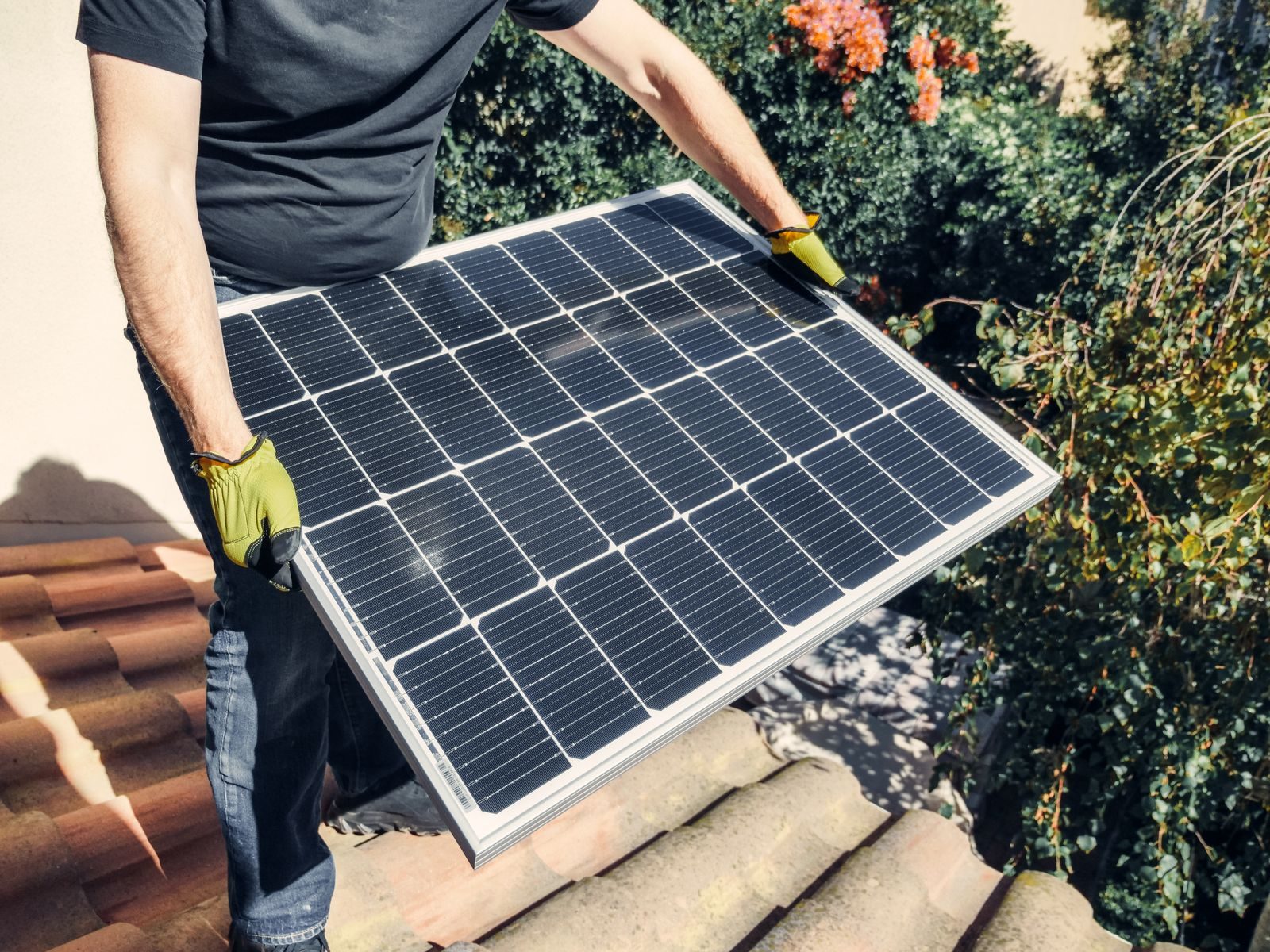
A licensed solar contractor (C-10 electrician or C-46 solar license) shuts the system down, unplugs the wiring, takes off the panels and pulls the rails and mounts. Panels usually get stacked on padded racks in the garage or the side yard. Please don’t let anyone just lean them against a wall in the sun with the glass facing out. We’ve seen cracked panels from exactly that.
Replace the roof
Now it’s a normal reroof. We tear off the old roofing, fix any bad plywood, put down new underlayment and install the new roof. The one big difference is that we mark every rafter where a mount will go and install new flashed mounts or mount bases as we roof. That way each one is sealed into the roof, not stuck on top of it later.
Put the panels back and turn it on
The solar crew sets the rails, reinstalls the panels, reconnects everything and tests the system. Depending on your city and what changed, there may be an electrical inspection before it can run again. Then you check your monitoring app and make sure every panel is reporting.
Plan it
- Roof inspection and quote.
- Solar company books the detach.
- Roof permit pulled and materials ordered.
Roof day
- Panels off and stored.
- Tear-off, deck repairs, new roof.
- New flashed mounts set on the rafters.
Back online
- Panels and wiring reinstalled.
- System tested and inspected if needed.
- Check every panel in your app.
Budget
What it costs to remove and reinstall solar panels in San Diego
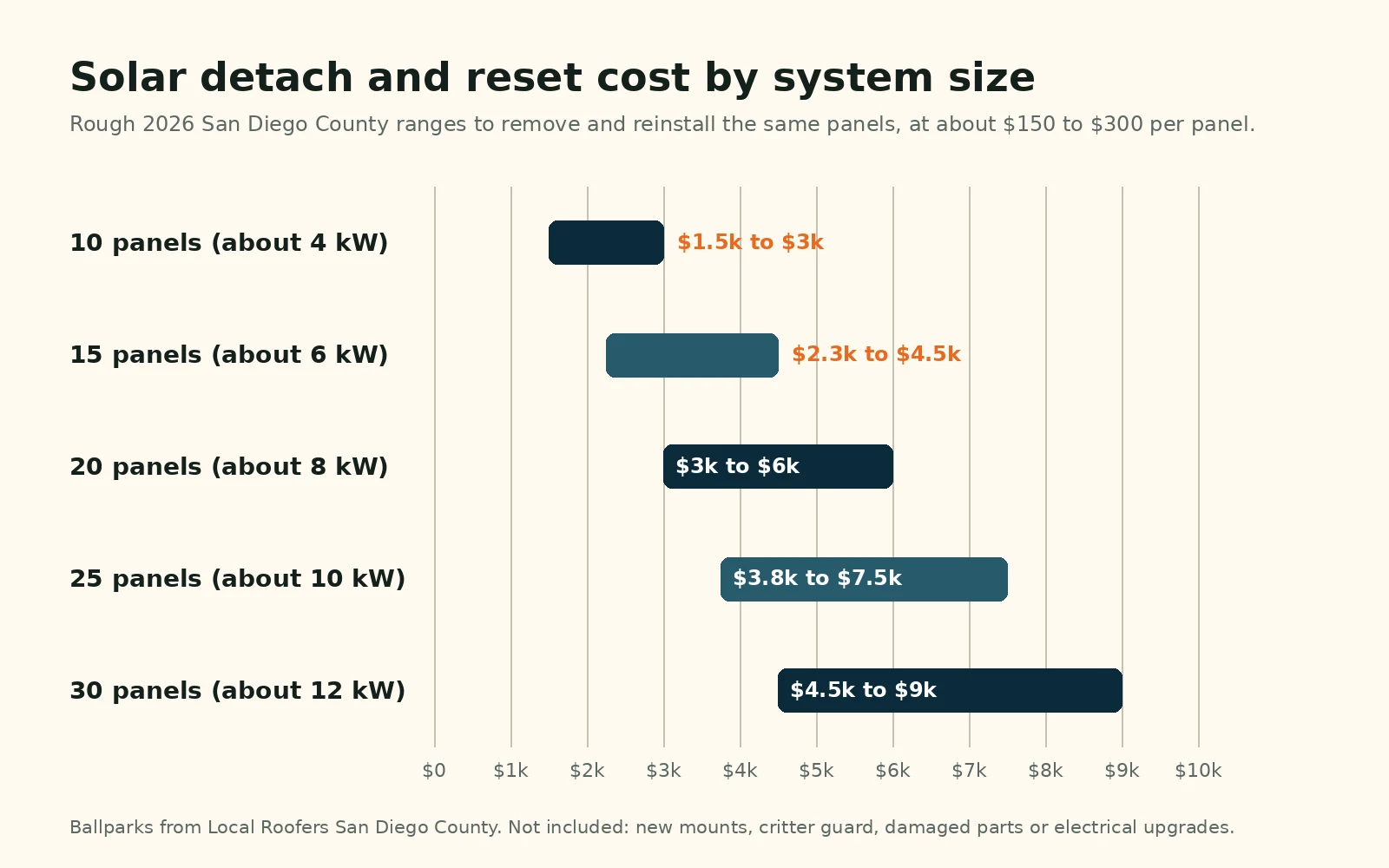
Most solar companies price a detach and reset per panel. Around San Diego County in 2026 we see quotes land somewhere between $150 and $300 per panel, with a minimum charge for small systems. For a 10-panel system that’s about $1,500 to $3,000. For 20 panels it’s about $3,000 to $6,000, and a 30-panel system runs about $4,500 to $9,000.
What pushes the price up
The per-panel price covers the basic labor. These are the extras that show up on real quotes:
- Tile roofs. Working on tile is slower, and tile mounts with replacement flashings cost more than shingle mounts.
- Steep or two-story roofs. More safety setup and more time for both crews.
- Old or discontinued parts. Some racking from 2012 to 2015 isn’t made anymore. If clamps or rails break, they may need new ones that fit.
- Critter guard. Pigeons love nesting under panels here. Adding mesh around the array while it’s being reinstalled is cheap compared to cleaning out nests later.
- Electrical updates. If something on the system has to be changed, the city may want it brought up to the current code, like newer rapid shutdown rules.
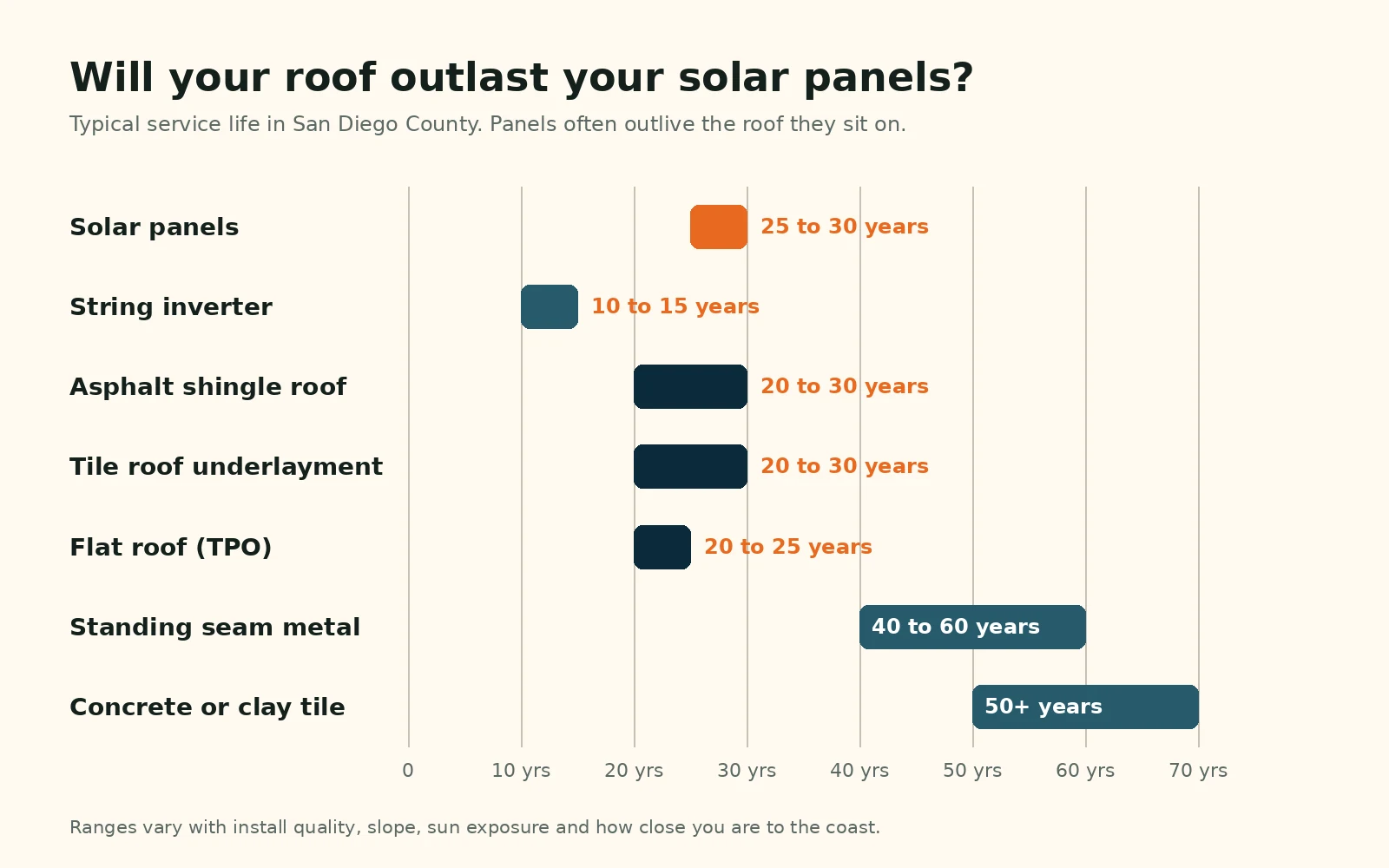
- A dead inverter. String inverters often last 10 to 15 years. If yours is close to the end, this is a good time to deal with it.
Roof price is a separate number. Our roof replacement cost guide for San Diego breaks that down by material.

Don’t lose what you have
Your SDG&E net metering plan and solar warranty
This is the part that worries people most, and it’s worth getting right.
Keeping NEM 1.0 or NEM 2.0
If your system was hooked up before the switch to the Net Billing Tariff in April 2023, you’re likely on a legacy net metering plan. Those plans run for 20 years from the date your system was first approved to operate. That’s a very good deal compared to what new solar customers get now, and you want to keep it.
In general, taking the same panels off for a reroof and putting them back doesn’t change your plan. Adding panels or upsizing the system is where you can get into trouble, because a bigger expansion can move the system onto the current tariff. Rules have specific limits, so before anyone touches the system, call SDG&E or ask your solar company to confirm in writing that your plan stays the same. If you want to add a battery or more panels while the roof is open, ask about that specifically.
Panel and racking warranties
Many solar warranties say removal has to be done by a certified or licensed installer. If the original company is still around, they’re often the best choice for the detach, even if they cost a little more. If they’re gone, which happens a lot in solar, use a licensed solar contractor and keep their invoice and photos with your house papers.
Leased panels and PPAs
If you lease the system or pay for the power under a PPA, you don’t own the panels. The leasing company usually has to do the removal or approve who does it, and some of them have a set process and fee for it. Call them first. Their scheduling is often the slowest part of the whole job, so we tell customers to start that call before they even pick a roofer.
Tax credits
The 30 percent federal tax credit for solar that homeowners buy ended for systems installed after 2025. A roof replacement was never covered by it anyway. What that means in practice is that new panels cost more out of pocket than they used to, so keeping your existing system working on a new roof matters even more.
Timing
Should you replace your roof before adding solar
If you don’t have solar yet but you’re thinking about it, look at your roof first. Panels are built to last 25 to 30 years. Plenty of roofs in San Diego won’t make it that long, and when the roof goes, the panels have to come off.
Here’s how we’d think about it:
- Roof under 10 years old. Go ahead with solar. Just make sure the installer flashes the mounts properly.
- Roof 10 to 20 years old. Get it inspected. It may only need some repairs, or it may make sense to replace it now and avoid a detach and reset in 8 years.
- Roof 20 years or older. Replace it first. You’ll almost certainly pay for a detach and reset later if you don’t, and your insurer may already be asking about the roof’s age. Our guide to roof age and home insurance in California covers that side.
If you already have solar and the roof is getting old, the same idea works backward. Don’t keep patching a roof that’s near the end just because the panels are on it. Each leak under an array is harder to find and harder to fix than a leak on an open roof.
By roof type
Tile, shingle and flat roofs with solar
The basic process is the same, but each roof type has its own details. These are the three we see most in the county.
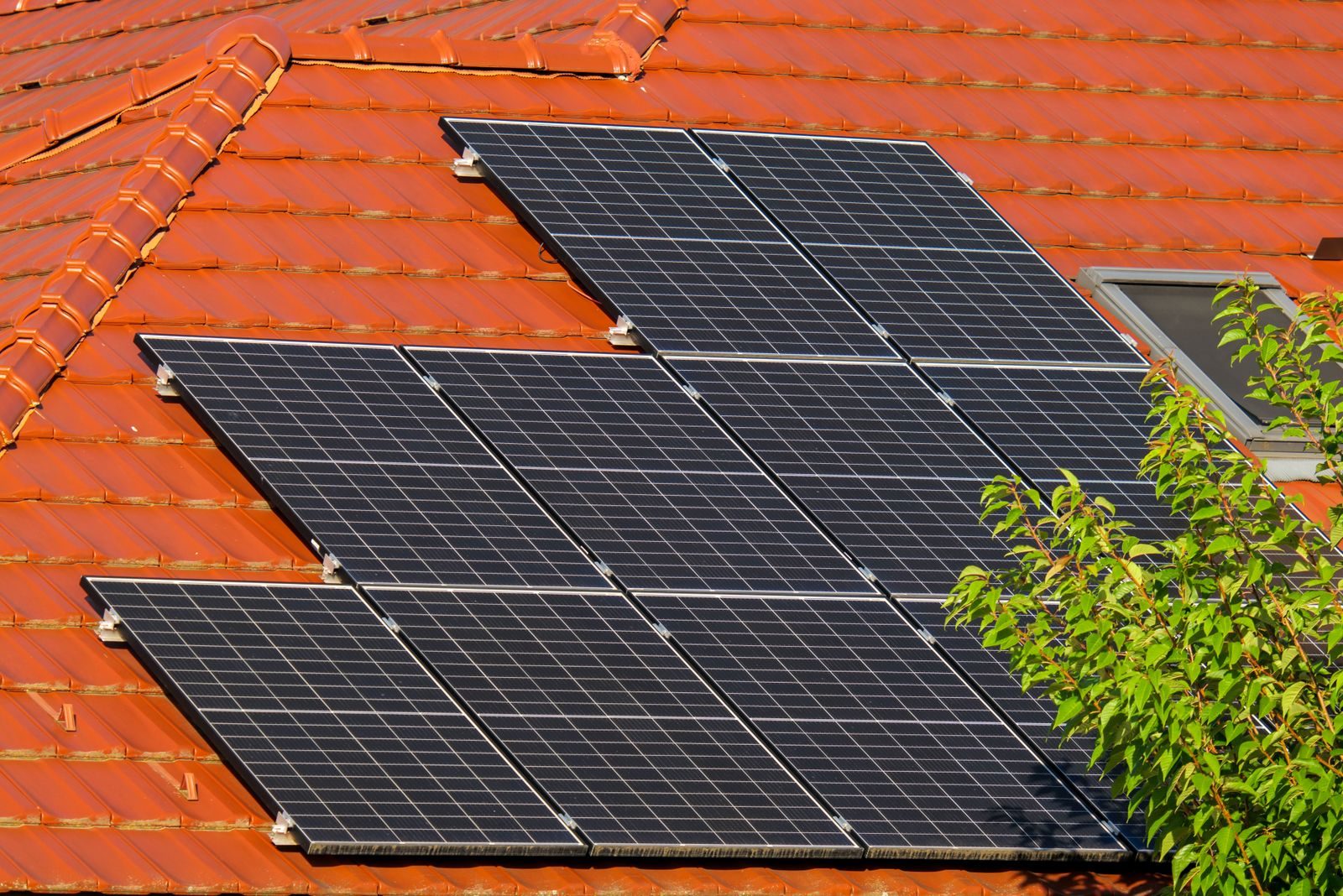
Lift and relay under the array
Lots of tile roofs here have good tile and worn-out underlayment. We can pull the tile, replace the underlayment and put the tile back, with new flashed tile hooks or replacement flashing tiles at each mount. Some homeowners choose to put shingles just under the array, since nobody sees that area and it means fewer broken tiles next time.
Tile roofingNew flashed mounts
The easiest roof for solar. We install the new shingles and a flashing plate at every mount so it tucks under the course above. Old mount holes in the deck get sealed or the plywood gets replaced. No one should be reusing the old holes and just caulking around them.
Shingle roofingMembrane and ballast or flashed posts
Lots of mid-century homes and commercial buildings have flat roofs with solar. With TPO we either use weighted racks that sit on protection pads, or flashed posts welded into the membrane. Ponding water around racks is the thing to watch.
TPO roofingLeak prevention
How to keep a solar roof from leaking
Most leaks we track down on solar roofs come from mounts that were never flashed, or mounts where someone relied on a blob of sealant that dried out a few summers later. Sealant has its place, but it shouldn’t be the only thing keeping water out.
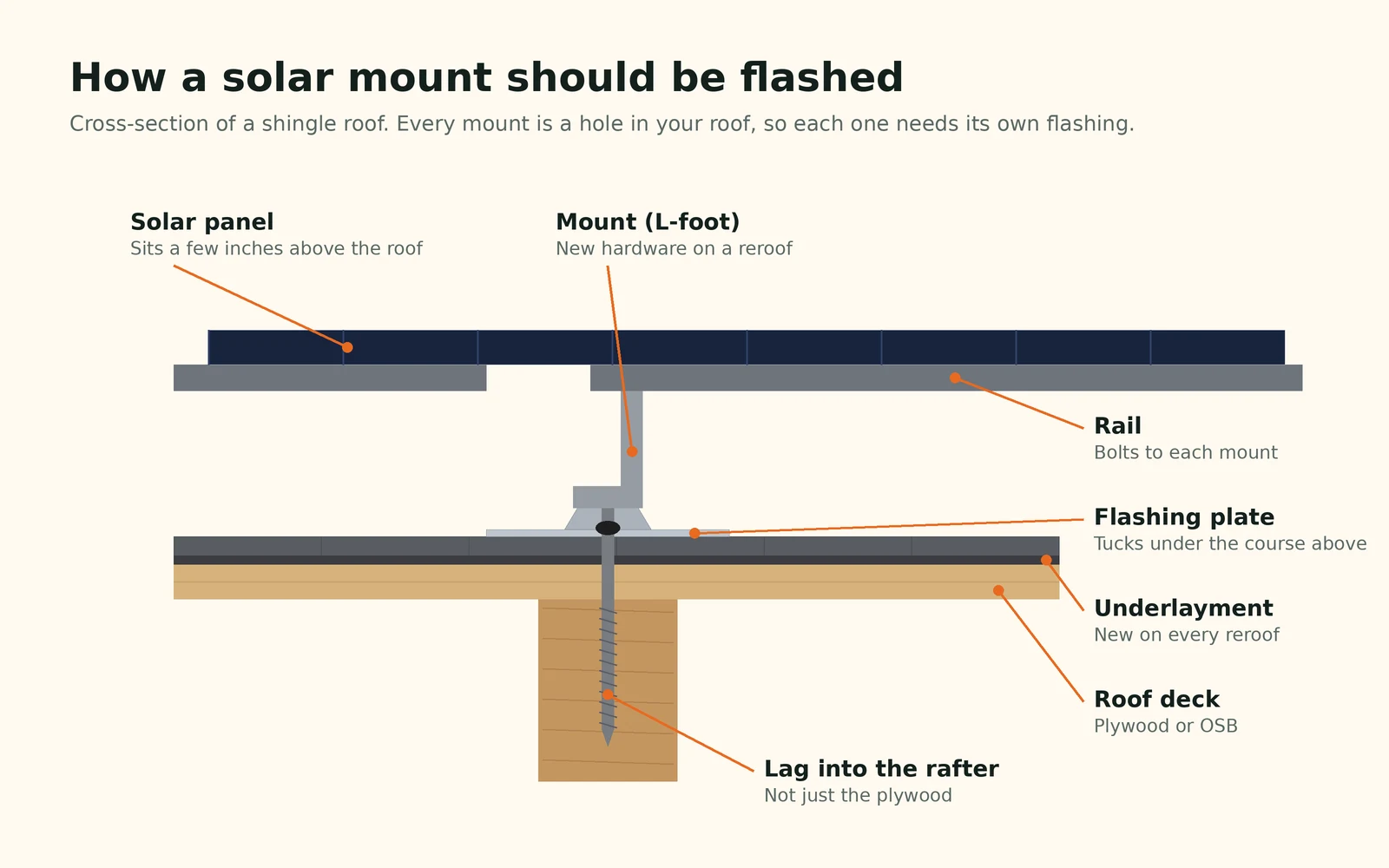
On a reroof, ask for these things:
- Every mount gets lagged into a rafter, not just the plywood.
- Every mount gets its own flashing, worked into the roof as it’s installed.
- Old holes in the deck get filled and sealed, or that plywood gets replaced.
- Wire runs and conduit get proper roof penetrations with boots or flashing, not a hole and caulk.
- Photos of the mounts before the panels go back on.
That last one matters. Once the panels are back, nobody can see the mounts without taking them off again. Ask for the photos and keep them. If El Niño brings the wet winter some forecasts are calling for, our El Niño roof prep guide is worth a look too.
Before you sign
7 questions to ask before you sign
- 01
Who is doing the solar part
Is it the roofer, a solar sub, or your original installer? Ask for their license number and look it up on the CSLB site.
- 02
Does the quote include both trades
Some roofing quotes leave out the solar completely. Make sure you know the full price before you compare.
- 03
Will my NEM plan stay the same
Get it in writing, especially if you’re adding panels or a battery.
- 04
Where will the panels be stored
Padded, flat, out of the way and not leaning in the sun. Who’s responsible if one breaks?
- 05
Are new mounts and flashing included
Reusing old mounts on a new roof is asking for leaks. New flashed mounts should be on the quote.
- 06
How long will I be offline
Ask for a date the panels come off and a date they go back on. Lost production for two weeks in summer adds up.
- 07
Who warranties the leaks
If a mount leaks next winter, does the roofer or the solar company come out? Get one answer, not two people pointing at each other.
One more thing on money. In California the down payment on a home improvement job is generally limited to $1,000 or 10 percent of the contract, whichever is less. The Contractors State License Board has more on hiring a contractor. And yes, your reroof still needs a permit. Our roof permit guide covers how that works in the city and the county.
Insurance
Does insurance pay for solar removal
If your roof is being replaced because of covered damage, like a storm or a tree coming down on it, the cost to take the panels off and put them back is usually part of the claim. Ask your adjuster to include it, and send them the solar company’s written quote.
If the roof is just old and worn out, insurance won’t pay for the roof or the detach and reset. Our roof storm damage guide explains what to do first if you think you have a claim.
Around the county
Solar roof replacements across San Diego County
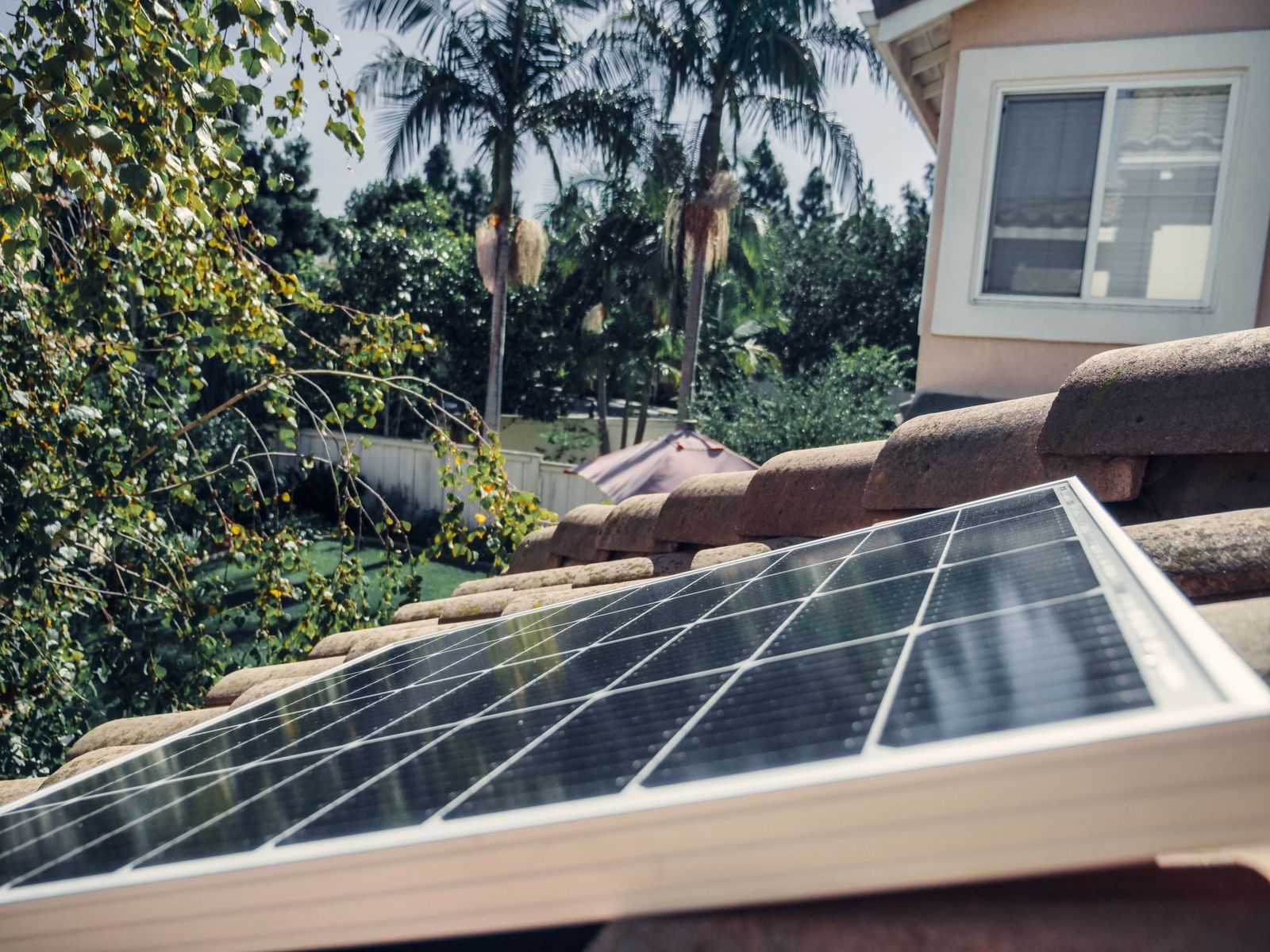
We do these jobs all over the county. Tile lift and relays under big arrays in Escondido and Rancho Bernardo. Shingle reroofs with solar in Chula Vista and Eastlake. Coastal homes in Oceanside and Carlsbad, where we use stainless hardware and coastal-rated flashing so the salt air doesn’t eat the mounts.
See our local pages for roofing in Escondido, Carlsbad, Oceanside and Chula Vista. If the roof only needs some care to last a few more years, our roof maintenance service includes checking around solar mounts. For businesses, our commercial roofing team handles flat roofs with large arrays.
Common questions
Solar and roof replacement FAQs
How much does it cost to remove and reinstall solar panels in San Diego?
Most quotes in San Diego County run about $150 to $300 per panel in 2026. For a typical home with 15 to 25 panels, that’s roughly $2,500 to $7,500, not counting the roof itself or extras like new mounts, critter guard or broken parts.
How long are solar panels off during a roof replacement?
Usually one to three weeks. The roof itself often takes two to five working days. The rest is scheduling the solar crew on both ends and any inspection needed before the system can run again.
Will I lose my NEM 2.0 plan if I replace my roof?
Removing and reinstalling the same system for a reroof generally doesn’t change your net metering plan. Adding panels or enlarging the system can. Confirm with SDG&E or your solar company in writing before work starts.
Can my roofer remove the solar panels?
Only if they’re licensed for that work, or they bring in a licensed solar contractor. Many panel warranties require a qualified installer. If your system is leased, the leasing company usually has to do it or approve who does.
Should I replace my roof before installing solar?
If your roof has less than about 10 years of life left, yes. Panels last 25 to 30 years, and taking them off for a reroof later costs thousands. Doing the roof first means you only pay for the panels to go up once.
Does homeowners insurance cover solar panel removal for a new roof?
If the roof is being replaced because of covered damage, the detach and reset is usually included in the claim. If the roof is just old, insurance won’t pay for the roof or the solar work.
Free roof estimate
Got solar and an old roof?
We’ll inspect the roof and the mounts, tell you honestly if it needs replacing yet, and work out the timing with your solar company so you’re offline as little as possible.