
Local Roofers San Diego County / Homeowner guide
Tile roof underlayment replacement in San Diego
Can you keep the tiles? What needs to change underneath? Here’s how to make sense of a lift-and-reset proposal before you commit.

Choose the scope
Repair, lift and reset, or replace the tile?
Ask for a recommendation tied to inspection findings. The age of the roof is useful background; photographs and the condition of the surrounding materials should explain why a particular scope makes sense.
Two bids can both say “underlayment replacement” while covering different amounts of roof. Have each contractor mark the proposed work on a roof photograph or plan. That simple step makes a partial repair much easier to compare with a whole-roof reset.

Below the tile
What should a lift-and-reset proposal include?
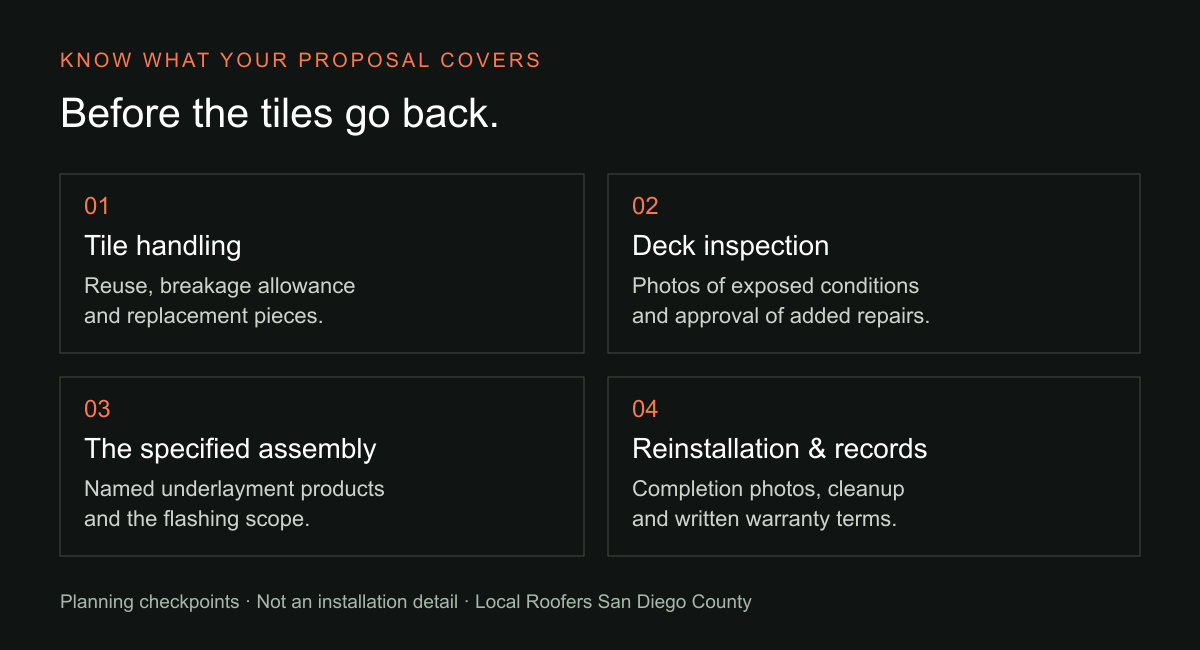
Expect the contractor to describe access and tile handling, removal of the existing underlayment, inspection of the exposed deck, installation of the specified assembly, and tile reinstallation. Any wood repairs or additional work should have a clear approval and pricing process.
The Tile Roofing Industry Alliance installation manual calls for removing cracked or broken tiles and replacing damaged, rusted or improper flashing during reroofing. A proposal that mentions only new paper leaves important questions unanswered.
Get the underlayment product in writing
“Premium synthetic” is too vague to compare. Request the manufacturer and product name, the proposed assembly, and the installation instructions it follows. Westlake Royal identifies several underlayment types; suitability depends on the roof and the applicable requirements. A material label alone doesn’t establish how it should be installed.
Ask for photographs before the tiles go back. Finished-roof photos are useful, but images of the exposed deck, new underlayment and flashing preserve a record of the work you’ll no longer be able to see.
Understand the estimate
What affects tile roof underlayment replacement cost in San Diego?
Reusing tiles can reduce the amount of new tile you need to buy. It still involves substantial removal and reinstallation work. Your estimate needs to account for the measured roof area, access, the selected materials, and the condition uncovered during removal.
Before relying on a price per square foot, confirm what area it uses. Your home’s interior floor area and the measured roof surface are different measurements. Also check whether the number includes the same flashings, replacement tiles, wood repairs and other work as the competing bid.
Ask for an itemized estimate after an inspection. An advertised range can be a starting point for questions, but it won’t tell you how much concealed repair work your roof needs or what the contractor has excluded.
A quote checklist you can use
| Line item | Question to ask |
|---|---|
| Roof area | Which slopes and how much measured roof surface are included? |
| Tile handling | What happens to unusable tiles, and how are additional replacement pieces priced? |
| Underlayment | Which exact product and assembly will be installed? |
| Flashing | Which valleys, walls, vents, chimneys and skylights are included? |
| Wood repairs | What is included, what costs extra, and who approves additional work? |
| Solar or equipment | Who handles any removal, reinstallation and coordination? |
| Permits and cleanup | Who confirms permit requirements, and are applicable fees and disposal included? |
| Warranty | What do the material and workmanship warranties each cover, and what is excluded? |
If one bid is lower, use the checklist to find out why. It may cover less area, leave more existing material in place, or exclude work another contractor has already allowed for. A clearly defined difference is easier to judge than a larger or smaller total on its own.
Plan around your property
Check permits, solar and access before work starts
Permit requirements depend on the address and the work. The City of San Diego’s Information Bulletin 123 identifies permit triggers for reroofing, including specified structural work and historic properties. Those City rules should not be assumed to apply throughout San Diego County. Have the contractor confirm the requirements with your building department.
If you have solar panels, ask which portions of the roof can be accessed and who is responsible for any panel work. If solar is planned, share that information before the roofing scope is finalized. Put the responsibilities and timing in the proposal.
For an HOA property, check architectural requirements before approving visible changes. Discuss replacement-tile appearance as well as where materials will be staged, how vehicles and landscaping will be protected, and whether work affects a shared driveway.
Before signing, check the contractor’s current license through the California Contractors State License Board and make sure the written agreement identifies the business doing the work.
Straight answers
Common questions
How long does tile roof underlayment last?
There is no single replacement age that fits every product and roof. Check installation records, repair history and current condition. Ask the inspector what evidence supports replacing it now, and distinguish a product warranty from an assessment of the installed roof.
Can you replace underlayment without removing the tiles?
The tiles covering the work area need to be removed to access the underlayment. A lift and reset refers to removing them and reinstalling those suitable for reuse. It does not mean replacing the layer through the gaps between tiles.
Can just one section be replaced?
Sometimes. Ask the contractor to identify the repair boundary and explain how the new work will connect to the remaining assembly. Also ask what the inspection found elsewhere on the roof and which areas the warranty will cover.
Will the roof look the same afterward?
Reusing the tiles can preserve much of its appearance, but ask about breakage and replacement pieces. Matching the profile and matching a weathered color are separate questions. Request an explanation of how visible replacements will be handled.
What should I do before the inspection?
Gather previous estimates, roof records and photos of interior leaks. Note when water appeared and whether the same area has been repaired before. Leave tile lifting and roof access to the contractor.
Local Roofers San Diego County
Get a clearer picture of what your roof needs.
Tell us about the roof, any recurring leaks, and the work you’re considering. Start with an inspection and a defined scope so you can make an informed decision about repair, underlayment replacement or a new roof.
Request an estimate