

2026 Santa Ana season guide
Zone 0, Santa Ana winds and your San Diego roof
California has new rules for the first five feet around your house. Here’s what they mean for your roof, and what we’d check before the next Red Flag Warning.
When most people in San Diego think about their roof, they think about rain. We wrote a whole El Niño roof prep guide for that. But October is also when the Santa Ana winds start, and this year the state changed the rules for the area right around your house.
On August 19, 2026, the California Board of Forestry approved rules for something called “Zone 0.” It’s the first five feet around a home in a Very High Fire Hazard Severity Zone, and the goal is to keep anything that can catch an ember away from your walls. Around the same time, new state fire maps put a lot more of San Diego County in that “very high” category, including neighborhoods that were never on the map before.
We get a lot of questions about this, so we put everything in one place. Below you’ll find what Zone 0 actually covers, how embers get into a house, which roofs are rated Class A, and a checklist you can walk through this weekend.
The new five-foot rule
What Zone 0 is (and why your roofer cares)
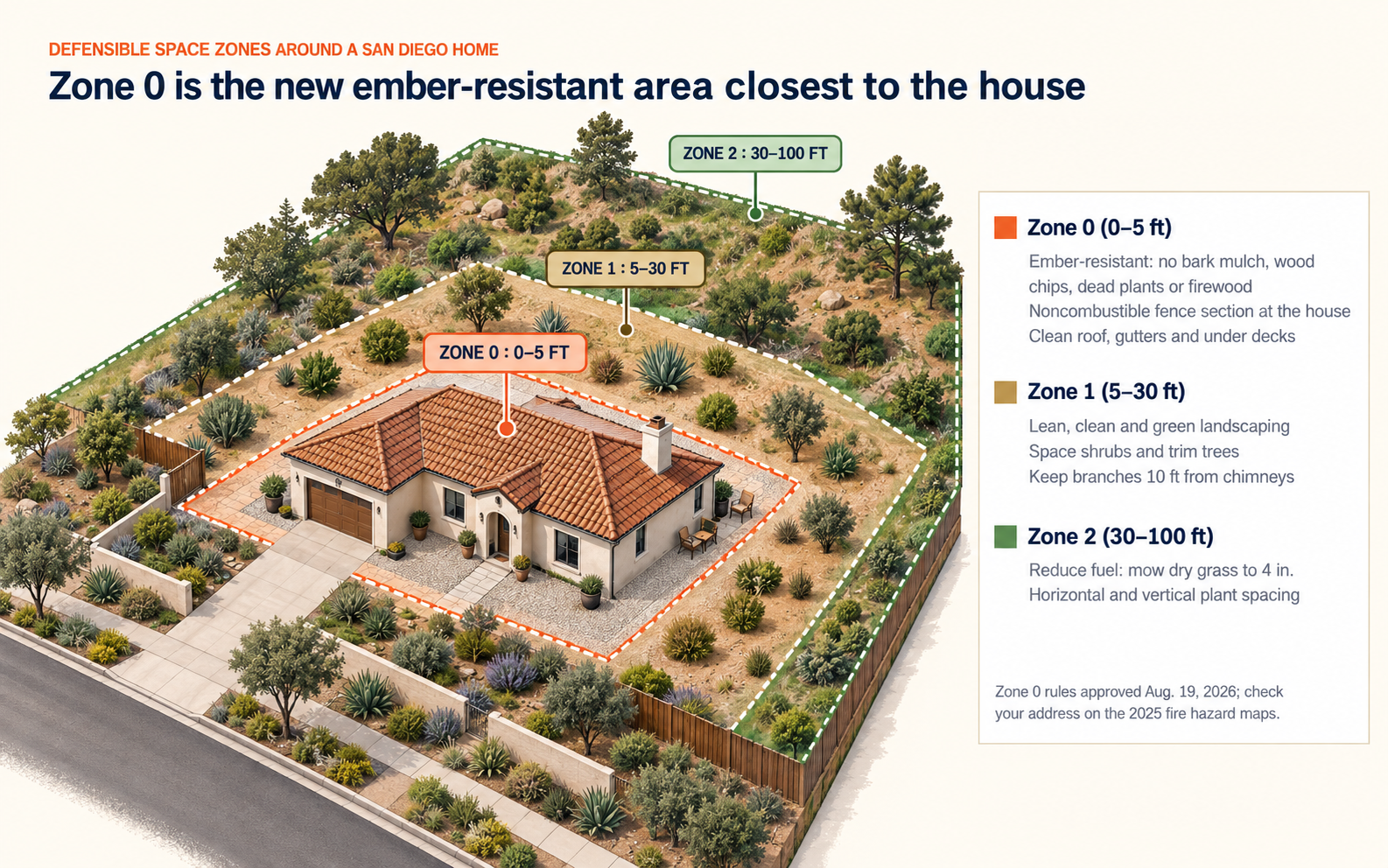
California has required defensible space in fire country for a long time. Zone 1 runs from about 5 to 30 feet out from the house. Zone 2 goes out to 100 feet. Zone 0 is new. It’s the five feet closest to your walls, plus any attached deck.
Think bark mulch against the foundation, dead plants, leaves piled up in corners, firewood stacked by the garage, and wood fences that tie right into the house. Those are the kinds of things Zone 0 is meant to clear out. Fences get a little more time. Where a fence meets the house, the last section will eventually need to be noncombustible, but that’s part of a later phase.
So why is a roofing company talking about mulch? Because your roof and that five-foot strip work together. Leaves sitting in your gutters and roof valleys are the same fuel Zone 0 is trying to get off the ground. Vents, eaves and the open ends of tile are all roof details too. You can have a perfect gravel border around the house and still lose it to a gutter full of dry leaves.
Check your address
Does Zone 0 apply to your home?
It applies to homes in Very High Fire Hazard Severity Zones. That includes areas CAL FIRE is responsible for (mostly unincorporated land) and areas covered by a city fire department. The second part is the big deal for San Diego.
The State Fire Marshal put out new maps for city-covered areas in 2025. The City of San Diego adopted them, and they took effect on August 30, 2025. KPBS reported that the county’s “very high” acreage went up by about 26%, from roughly 647,000 acres to about 871,000. A lot of that growth was in regular suburban neighborhoods.
How to look up your house
If you’re in the City of San Diego, use the city’s fire hazard zone map. Carlsbad, Escondido, Oceanside, Chula Vista, Poway, Santee, Del Mar and the other cities each adopt their own map, so check your city or fire district website. If you’re in an unincorporated area, the State Fire Marshal has a map viewer online.
Canyon homes are the ones we worry about most
A lot of San Diego homes back right up to native brush. We see it all the time on canyon rims in Scripps Ranch, Rancho Peñasquitos, Tierrasanta, Mission Hills and Clairemont, and out in Ramona, Alpine, Valley Center and Fallbrook. And even if your house isn’t in a mapped zone, the wind doesn’t care. Most of the checklist below is worth doing anywhere the Santa Anas blow.
Embers vs. flames
Most houses burn because of embers
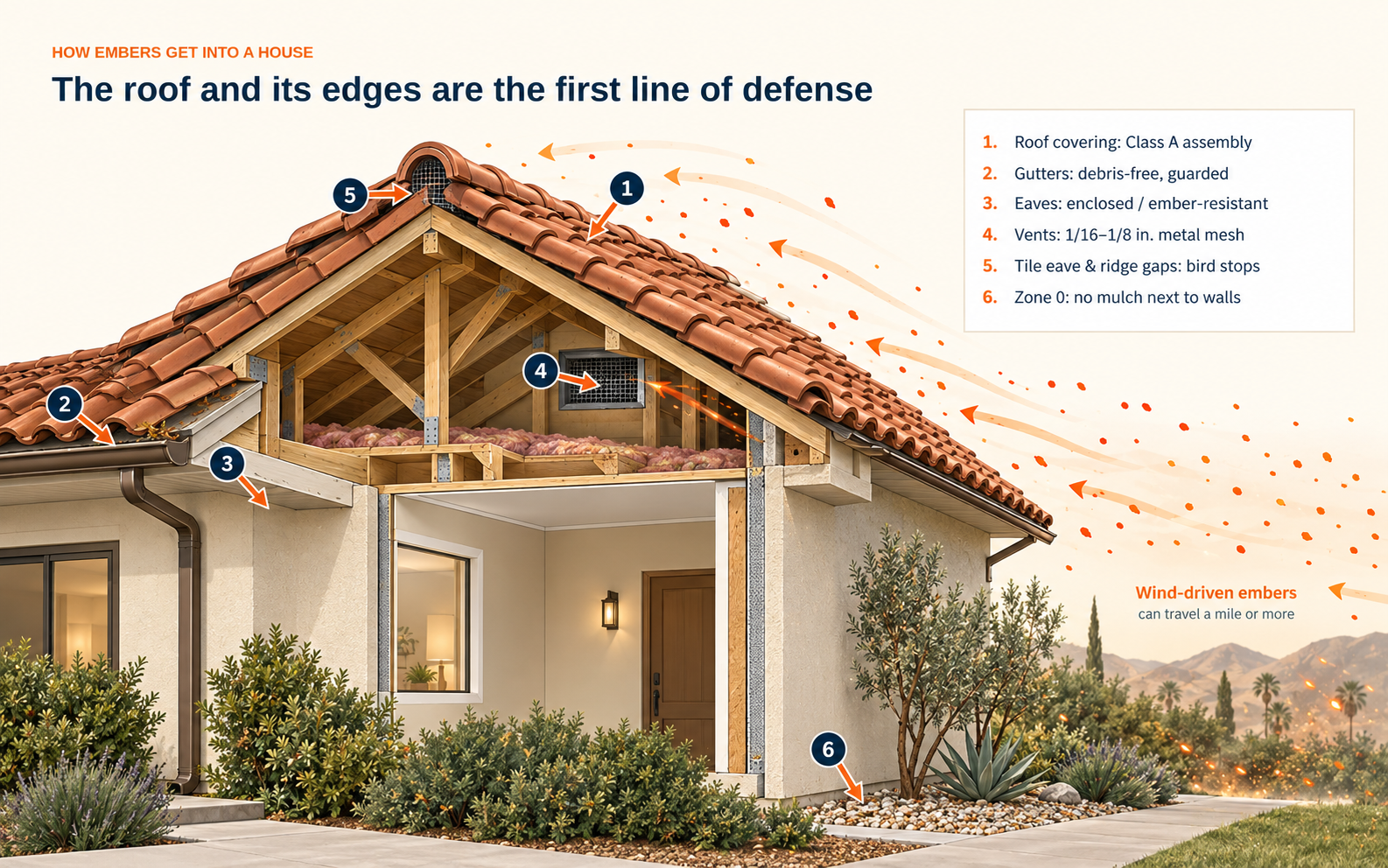
When a Santa Ana is blowing, burning bits of brush and wood can fly a long way ahead of the actual fire. They land on the roof, blow into gutters and valleys, get stuck in the open ends of tile, and get sucked into attic vents. A house can catch fire from the inside, or from a pile of leaves in the gutter, while the main fire is still a mile off. That’s why so much of the fire safety advice out there is about roofs, vents and that first five feet.
San Diego actually has a head start here. Tile, metal and Class A shingles are everywhere in the county. Where we usually find problems is in the details. Old vents with big or rusted screens. Open eaves. Missing bird stops on tile roofs. Valleys packed with leaves. Patches done with whatever was in somebody’s truck.
Wildfire roof checklist
8 things to check before Red Flag season
Do what you can from the ground and from inside the attic. Please don’t climb up there yourself. Tile cracks when you step on it, and a fall isn’t worth it.
- 01
Find out your roof’s fire rating
Dig up the permit, the invoice, or the product name. In fire hazard zones, California’s wildfire building code calls for a Class A roof. If you replace more than half the roof in a year, the whole thing generally has to meet Class A. Untreated wood shakes don’t qualify.
- 02
Clean the roof, valleys and gutters
Leaves, palm fronds, pine needles and eucalyptus bark are basically kindling. Clean them out before fall, then again after big wind days. For new work in fire zones, gutters need something that keeps debris out, so it’s worth asking about metal gutter guards.
- 03
Upgrade the vents
Vents are the easiest way for an ember to get into the attic. You want vents rated to resist embers, or metal mesh with openings between 1/16 and 1/8 inch. If a screen is torn, rusted out or painted shut, replace it.
- 04
Close up tile ends
Barrel and S-tile leave gaps at the eaves and ridge. Those need to be closed off, usually with bird stops. On older tile roofs around here, they’re missing or broken more often than not. Our tile roofing crew checks them on every inspection.
- 05
Look under the eaves
Open eaves with exposed rafter tails can trap heat and embers. Boxing them in with noncombustible or ignition-resistant soffit material is one of the standard home-hardening steps. Also look for gaps where the soffit meets the wall.
- 06
Check the valleys and roof edges
In fire zones, valleys are supposed to have metal flashing over a wide cap sheet, not just felt paper. Loose drip edge and rotted fascia give embers somewhere to settle, too.
- 07
Cut back branches
Keep limbs off the roof and at least 10 feet from the chimney. Hire a tree service for big limbs or anything near power lines.
- 08
Clear the first five feet
Swap the bark mulch next to the house for gravel, decomposed granite or pavers. Move firewood and trash cans away from the walls, and clean out under the deck. That’s the heart of Zone 0, and it protects the eaves and siding right below your roofline.
If this turns into a reroof or a bigger repair, read our roof permit guide for San Diego first. A permitted job gives you paperwork your insurance company will want later.
Roofing materials
Class A roof options for San Diego homes
Class A is the top fire rating a roof can get. Some roofing products earn it on their own. Others only get it when they’re installed over a specific underlayment, which is called a Class A “assembly.” Ask your roofer which one you have, and get it in writing.
Clay and concrete tile
The classic San Diego roof, and it won’t burn. The weak spots are the open ends at the eaves and ridge, leaves in the valleys, and old underlayment under the tile. If the tile is fine but the underlayment is shot, we can lift the tile, redo what’s under it, and put the same tile back. More on that in our tile underlayment guide.
Tile roofingStanding seam and metal tile
Metal doesn’t burn, and leaves slide off it pretty easily. It’s also a lot lighter than tile. Most metal roofs hit Class A as an assembly, so the underlayment matters. Make sure the ridge and eave closures are solid or ember-resistant, not open foam.
Metal roofingClass A asphalt shingles
Most modern architectural shingles are rated Class A, which makes them a budget-friendly pick for canyon homes. Watch the ridge vent, the drip edge and the valleys. That’s where embers tend to pile up.
Asphalt shingle roofing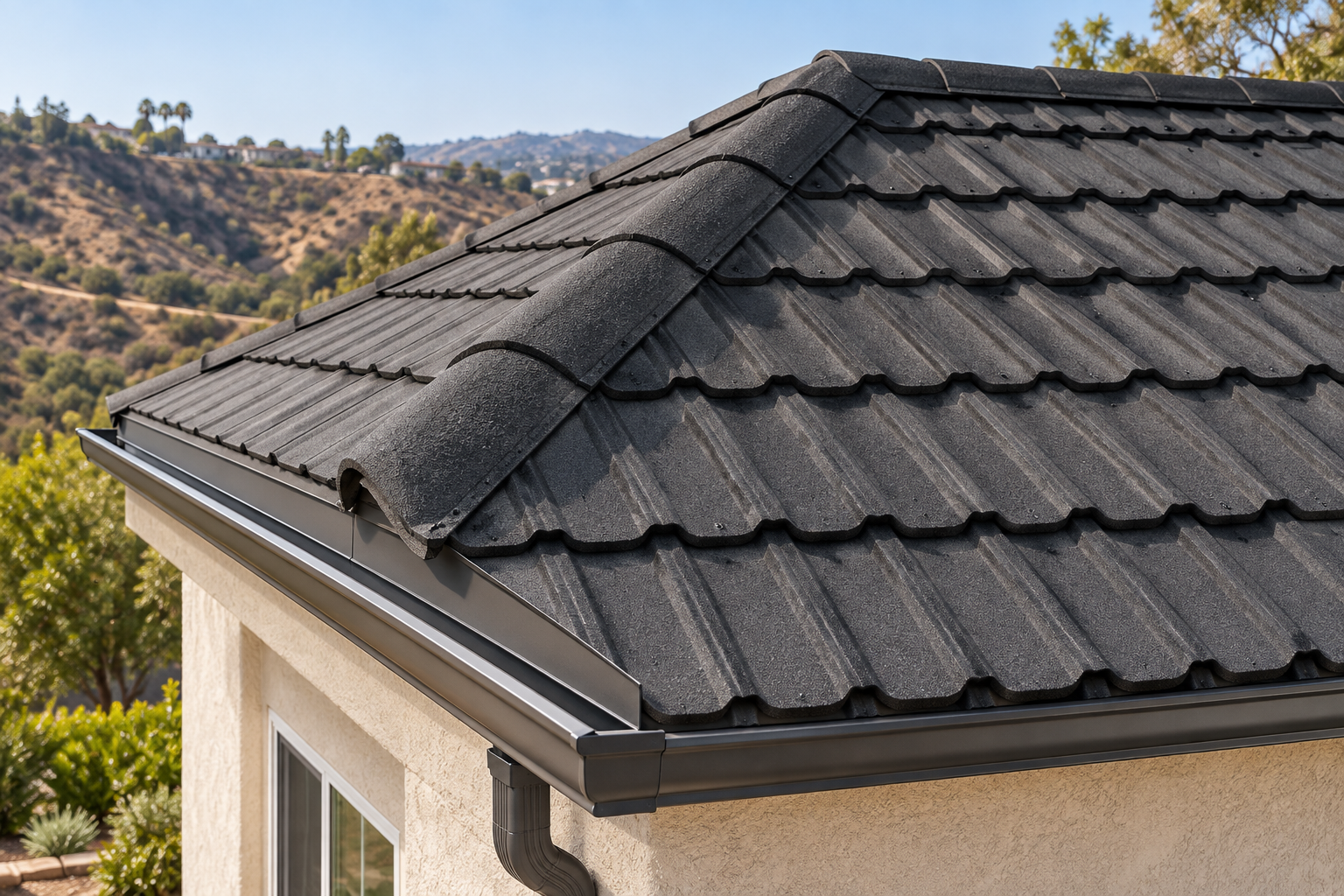
Got a flat roof? A lot of businesses and mid-century homes around here do. Membranes like TPO can be installed as Class A assemblies too. It comes down to the whole system, including the cover board, and keeping drains and parapet corners clear. If you manage a commercial building, our commercial roofing team can look at equipment curbs and rooftop vents with you.
Insurance
Your roof might help with your insurance bill
Class A roofTile, metal and Class A shingles all count.
Ember-resistant ventsMetal mesh between 1/16 and 1/8 inch, or rated vents.
Enclosed eavesSoffits made from noncombustible or ignition-resistant material.
6 inches at the baseNoncombustible material on the bottom six inches of your exterior walls.
5-foot ember zoneThe first five feet cleared, fence connections included.
Anyone who’s shopped for home insurance in California lately knows it’s rough, especially in fire-prone ZIP codes. The state Department of Insurance has a program called Safer from Wildfires. It requires insurers to give discounts on the wildfire part of your premium for certain upgrades, and several of them are roof items. How much you save depends on your insurer, and a discount doesn’t guarantee they’ll renew you. Call your agent and ask which upgrades they give credit for and what proof they want. Usually that means photos, invoices, product info and the final permit sign-off.
Santa Ana wind plan
Before, during and after a wind event
Santa Anas usually show up between October and March. A wet El Niño winter doesn’t cancel them, and a rainy year grows extra grass that dries out into next year’s fuel. When the National Weather Service puts out a Red Flag Warning or a wind advisory, here’s the plan.
Get ready
- Finish roof, gutter and vent work while it’s calm.
- Clean off the roof and gutters.
- Move patio cushions, doormats and firewood away from the house.
- Take photos of your roof and the outside of the house.
- Sign up for AlertSanDiego.
Stay off the roof
- No ladders or roof climbing in high wind.
- Close windows and garage doors.
- Keep a go-bag by the door.
- If you’re told to evacuate, go. Don’t stay to hose down the roof.
- Follow NWS San Diego and county updates.
Look it over
- From the ground, look for slipped tile, lifted shingles or loose metal.
- Check the attic for debris, a smoky smell or daylight.
- Take photos before you clean anything up.
- Get a professional inspection.
- Watch out for door-to-door storm chasers.
Please be careful: Wind, loose tile and ladders don’t mix. Wind damage is also hard to spot from the ground. If you think something’s wrong, stay off the roof and see our roof storm damage guide for what to do next.
Repair or replace?
Most homes don’t need a new roof for this
A lot of San Diego roofs are already Class A. If yours is, the fixes that matter most are usually small ones. New vents, bird stops, gutter guards, a valley cleanout, closing up gaps at the eaves. Most of that is a day or two of work and costs far less than a new roof.
Replacing makes more sense if the roof is near the end of its life, if the underlayment under your tile has failed, or if the roof isn’t Class A to begin with (old wood shake, for example). And if you’re reroofing anyway, that’s the time to do it right. Ask for metal valley flashing, a Class A assembly, and ember-resistant vents at the ridge and eaves.
What to ask for in a wildfire roof inspection
- What your roof covering is, and whether it’s part of a Class A assembly
- Photos of every vent, the eave closures and the valleys
- How your gutters look, and whether guards make sense
- A written quote that separates the fire items from regular repairs
- Paperwork you can send to your insurance company
Regular upkeep keeps all this working. Our roof maintenance visits include debris cleanup, a vent check and photos. We work all over the county, including Escondido, Carlsbad, Oceanside and Chula Vista. Whoever you hire, check their license with the Contractors State License Board first.
Common questions
Zone 0 and fire-resistant roof FAQs
When do the Zone 0 rules take effect?
The Board of Forestry approved them on August 19, 2026, and sent them to the Office of Administrative Law for review. Officials expected them to take effect around the end of September 2026. New homes have to comply once they’re live. Existing homes get a phase-in period, usually about three years, and some local agencies can allow longer.
Do I have to replace my roof because of Zone 0?
No. Zone 0 is about the five feet around your house, like mulch, plants, firewood and fences. Roof rules come from California’s wildfire building code, which requires Class A roofs in fire hazard zones for new roofs and for replacing more than half a roof within a year. Keeping your roof and gutters clean helps with both.
Is my tile roof already fire-resistant?
Clay and concrete tile won’t burn, and they’re generally Class A. The risk is in the details, like open ends at the eaves and ridge, broken tiles, leaves in the valleys and old underlayment. A good tile inspection covers all of that.
What are ember-resistant vents?
They’re vents made to keep embers and flames out of your attic. Either they’re a rated product, or they’re covered with metal mesh that has openings between 1/16 and 1/8 inch. They’re one of the cheapest upgrades that makes a real difference.
Can a fire-resistant roof lower my insurance?
It can help. California’s Safer from Wildfires program requires insurers to offer discounts for certain upgrades, including a Class A roof, ember-resistant vents and enclosed eaves. The amount depends on your insurer, and a discount doesn’t guarantee a renewal.
How do I know if I’m in a Very High Fire Hazard Severity Zone?
Look up your address on your city’s fire hazard map. City of San Diego residents can use the city’s fire zone map. If you’re in an unincorporated area, use the State Fire Marshal’s map viewer.
Wildfire roof inspection
Find the weak spots before the wind does
We’ll look at your roof, vents, eave closures, valleys and gutters, then send you photos and a written quote. No pressure. Just an honest answer about what your roof needs.